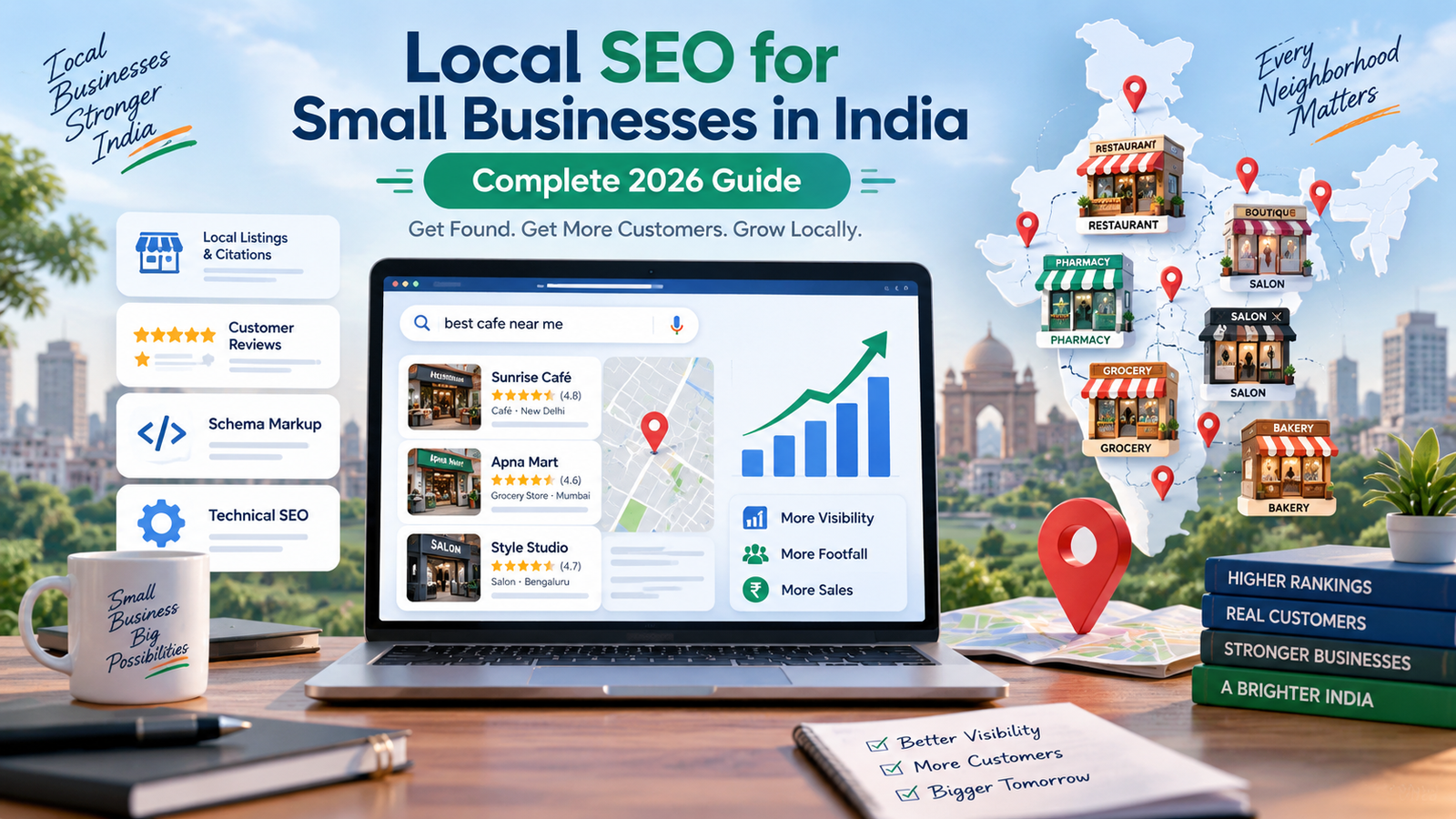
For a small business, being visible when nearby customers search can directly affect calls, enquiries, store visits and sales. Local SEO helps businesses improve their visibility in location-based Google searches, Google Maps and other local discovery platforms.
For small businesses in India, local SEO can be especially valuable because customers frequently search for services using city names, neighbourhoods and phrases such as “near me.” A strong local SEO strategy helps Google understand what your business offers, where it operates and which searches it should appear for.
Businesses can also improve their online presence by appearing in a trusted local business directory in India, where potential customers can discover companies by category and location.
What Is Local SEO and Why Does It Matter for Small Businesses in India?
Local SEO is the process of improving a business's online presence so it can appear more prominently when people search for products or services within a particular location.
For example, someone may search for:
- dentist in Delhi
- restaurant near me
- salon in Noida
- property dealer in Gurgaon
- AC repair in Mumbai
For businesses serving specific cities or areas, these searches often have strong commercial intent.
According to Google's local ranking guidance, local results are mainly influenced by relevance, distance and prominence. Relevance considers how closely a business matches the search, distance considers its location relative to the searcher, and prominence considers how well-known the business is.
How Local SEO Works
Local SEO gives search engines clear information about your business, including its services, address, operating area, website and reputation.
Google can obtain local business information from a company's website, publicly available web information, user contributions, third-party sources and its Google Business Profile.
A strong local business SEO strategy therefore combines:
- Google Business Profile optimization
- Location-focused website content
- Local keyword research
- Business directories and citations
- Customer reviews
- Local links
- Technical SEO
- Local Business schema
These signals work together rather than independently.
If your business is still developing its online presence, this guide on how to get your local business found online in India covers additional steps such as business listings, reviews and online visibility.
Understanding Local Search Intent
Local search intent means that the person searching wants a product, service or business connected to a particular geographic area.
Different searches can show different types of intent:
- how does plumbing work — Informational
- plumber in Delhi — Local commercial
- emergency plumber near me — Immediate local intent
- best plumber in Noida — Local comparison
When creating local SEO content, think about what the customer actually wants rather than simply inserting city names into pages.
Businesses operating across different locations can also study how customers browse businesses by city to understand the importance of location-based discovery.
How to Do Local SEO: Build an Effective Local SEO Strategy
If you are wondering how to do local SEO, begin by identifying the locations, services and customer searches that matter most to your business.
An effective local SEO strategy should connect your website, Google Business Profile, business listings and customer reputation.
Small businesses with limited marketing budgets can also combine SEO with these free ways to promote your local business online in India.
Find the Right Local SEO Keywords
Keyword research helps you understand how customers describe your products or services.
Common patterns include:
- Service + city
- Service + neighbourhood
- Product + city
- Business type + near me
- Best + service + location
- Emergency + service + location
For example, a dental clinic in Pune could target terms such as “dentist in Pune,” “dental clinic Pune” and relevant treatment-based local searches.
Google Keyword Planner can help businesses discover keyword ideas and refine research by location and estimated search activity. This is particularly useful when comparing demand across different Indian cities or regions.
Avoid targeting every keyword on one page. Group keywords by search intent and create useful pages around individual services and locations.
Optimize Your Website for Local Business SEO
Your website should clearly explain who you are, what you offer and where you operate.
For better local business SEO, optimize:
- Page titles
- H1 and H2 headings
- Service descriptions
- Contact details
- Location information
- Internal links
- Image alt text
- Mobile usability
- Page speed
If your business operates in several locations, consider creating useful location pages rather than duplicating the same content and changing only the city name.
Each location page should provide genuine information such as available services, service areas, business details, directions, FAQs and locally relevant information.
Optimize Your Google Business Profile and Google Maps SEO
Your Google Business Profile is one of the most important parts of local SEO because it can help your business appear across Google Search and Maps.
According to Google's guidance for improving local rankings, businesses should maintain complete and accurate information to improve their chances of appearing in relevant local searches.
Google Business Profile Optimization Checklist
Use this checklist for Google Business Profile optimization:
- Verify your Business Profile.
- Use your correct business name.
- Select the most accurate primary category.
- Add relevant secondary categories.
- Keep your address and phone number accurate.
- Add correct opening hours.
- Complete your service or product information.
- Upload useful business photos.
- Keep important information updated.
- Respond professionally to customer reviews.
Do not add unnecessary keywords to your business name simply to influence rankings. Your profile should accurately represent your real business.
How to Improve Your Google Maps SEO and Local Rankings
Google Maps SEO is not about finding a secret trick to reach position one.
Google states that businesses cannot request or pay for better organic local rankings. Its local ranking systems primarily consider relevance, distance and prominence.
To improve your local SEO visibility:
- Keep business information accurate.
- Choose relevant business categories.
- Optimize your website for services and locations.
- Earn genuine customer reviews.
- Build trustworthy local citations.
- Earn relevant links and mentions.
- Keep your website useful and accessible.
Distance is something a business cannot fully control, so focus on improving relevance, business information and overall prominence.
Build Local Trust with NAP Consistency, Reviews and Citations
Search engines and customers should find consistent information about your business across the web.
This is where NAP consistency, reviews and local citations become important.
Maintain NAP Consistency Across Business Listings
NAP stands for:
- Name
- Address
- Phone number
Your core business information should remain consistent across your website, Google Business Profile and relevant business directories.
Small formatting differences are generally less concerning than conflicting information. The main goal is to avoid outdated addresses, incorrect phone numbers and duplicate or misleading business details.
For Indian businesses, trustworthy business listing sites in India can provide additional discovery opportunities while helping companies maintain a consistent online presence.
Build Reviews and Local Citations
A local citation is an online mention or listing of your business information.
Relevant directories, industry platforms and trusted local websites can strengthen your online presence. However, businesses should focus on useful and relevant listings instead of submitting their details to hundreds of low-quality directories.
If you are deciding between different listing options, understanding the difference between a free business listing and paid business listing can help you choose where to invest your time and budget.
Customer reviews are equally important. Google states that more reviews and positive ratings can contribute to local prominence and help a business stand out.
Businesses may ask genuine customers for feedback, but Google's review guidelines prohibit offering incentives such as discounts or free products in exchange for reviews.
Good customer experiences also make genuine positive reviews more likely. Avoiding common customer service mistakes small businesses make can therefore support both reputation and customer retention.
Strong service can also help businesses turn first-time customers into loyal customers, creating repeat business alongside stronger word-of-mouth visibility.
Technical SEO for Local Search
Good local SEO also depends on a website that search engines can crawl, understand and index.
Technical SEO for local search should support both search engines and the customer experience rather than becoming unnecessarily complicated.
Improve Mobile Speed, Indexing and Location Pages
Many local searches happen when users need information quickly. Your website should therefore work properly on mobile devices.
Check important technical elements such as:
- Mobile usability
- Page loading speed
- HTTPS security
- Crawlable navigation
- XML sitemap
- Indexable pages
- Correct canonical URLs
- Broken links
- Duplicate location pages
Google uses the mobile version of a website's content for indexing and ranking. Its mobile-first indexing guidance recommends making sure important content, structured data and metadata are accessible on mobile.
Website owners should also monitor Core Web Vitals. Google's Core Web Vitals guidance defines “good” performance as an LCP of 2.5 seconds or less, INP of 200 milliseconds or less, and CLS of 0.1 or less, assessed at the 75th percentile of page visits.
Add Local Business Schema
Local Business schema is structured data that helps search engines understand information about a business.
Google's official LocalBusiness structured data documentation explains how businesses can provide structured information such as business type, address, opening hours and other details.
Use the most specific business type available where appropriate. For example, a restaurant can use the Restaurant type rather than relying only on the broader LocalBusiness type.
Schema helps search engines understand business information, but adding schema alone does not guarantee higher local rankings.
How to Perform a Local SEO Audit and Analysis
A local SEO audit helps identify problems that may be limiting your search visibility.
Your local SEO analysis should examine both your website and your external business presence.
Review:
- Google Business Profile
- Keyword visibility
- Website optimization
- Location pages
- NAP consistency
- Local citations
- Reviews
- Backlinks
- Indexing
- Technical problems
- Competitor visibility
Performing a local SEO audit regularly can help identify outdated information, technical issues and new opportunities for growth.
How to Check and Find Your SEO Ranking
If you are researching how to check SEO ranking or how to find SEO ranking, start with Google Search Console instead of repeatedly searching Google manually.
The Google Search Console Performance report provides useful information such as:
- Clicks
- Impressions
- Click-through rate
- Average position
- Search queries
- Pages
- Countries
- Devices
Use query and page filters to understand which local keywords and landing pages generate organic visibility.
Rather than focusing only on one ranking position, monitor longer-term changes in impressions, clicks, enquiries and conversions.
Best Local SEO Software and Tools
The best local SEO software depends on what you need to measure.
Useful local SEO tools include:
- Google Search Console — Organic search performance
- Google Business Profile — Local business presence
- Google Keyword Planner — Keyword research
- Google Analytics — Website traffic and behaviour
- PageSpeed Insights — Website performance
- Semrush — Keyword and competitor research
- Ahrefs — Backlinks and keyword analysis
Small businesses can begin with Google's free tools before investing in advanced SEO platforms.
When Should You Consider a Local SEO Audit Service?
A professional local SEO audit service may be useful when your business has multiple locations, ranking problems, conflicting listings or technical issues that are difficult to diagnose internally.
Before hiring an SEO provider, ask what they will audit, which tools and data they use, what recommendations you will receive and how results will be measured.
Avoid providers promising guaranteed number-one Google Maps rankings. Google's official local ranking guidance clearly states that businesses cannot request or pay Google for better organic local rankings.
Common Local SEO Mistakes to Avoid
Even a strong local SEO strategy can fail when basic business information or optimization practices are incorrect.
Avoid these common mistakes:
- Keyword stuffing
- Fake or incentivized reviews
- Duplicate location pages
- Incorrect business categories
- Inconsistent contact details
- Ignoring customer reviews
- Creating thin city pages
- Buying low-quality links
- Tracking rankings without measuring enquiries
- Expecting immediate results
Focus on helping real customers find accurate information and make informed decisions.
Local SEO Checklist for Small Businesses in India
Use this simple local SEO checklist:
- Research relevant local keywords.
- Optimize your Google Business Profile.
- Keep your NAP information consistent.
- Optimize service and location pages.
- Add appropriate Local Business schema.
- Earn genuine customer reviews.
- Add your business to relevant directories.
- Build relevant local links and mentions.
- Check mobile performance.
- Monitor Search Console data.
- Perform a local SEO audit periodically.
- Update outdated business information.
Businesses looking for another local discovery channel can also list your business for free on LocalBizIndia and provide important information such as your category, city, location, contact details, website and services.
Local SEO works best as an ongoing process rather than a one-time optimization project.
Frequently Asked Questions About Local SEO
What Is Local SEO and How Does It Work?
Local SEO improves the visibility of businesses in location-based search results. It combines website optimization, Google Business Profile management, local keywords, reviews, citations, links and technical SEO signals to help search engines understand a business's relevance to local searches.
Why Is Local SEO Important for Small Businesses in India?
Local SEO for small businesses in India can help companies reach customers who are actively searching for nearby products or services. It can be particularly useful for restaurants, clinics, salons, repair businesses, professional services, retailers, and other businesses serving defined locations.
How Long Does Local SEO Take to Show Results?
There is no fixed timeframe. Results depend on competition, website quality, location, business prominence, reviews, existing authority, and the amount of optimization required. Monitor improvements in impressions, clicks, enquiries, and local visibility instead of expecting immediate ranking changes.
Is Local SEO Worth It for Small Businesses?
For businesses that depend on customers from a particular city, neighbourhood or service area, local SEO can be a valuable marketing channel because it reaches users who are already searching for relevant nearby products or services.
How Often Should You Perform a Local SEO Audit?
A basic local SEO audit can be performed every few months and after major website, address, phone number or business changes. Companies managing several locations may need more frequent monitoring.
What Is the Difference Between SEO and Local SEO?
Traditional SEO can target national or international searches, while local SEO focuses primarily on location-based searches and local business discovery. Local optimization places greater emphasis on Google Business Profile, Google Maps, customer reviews, citations, location pages and accurate business information.