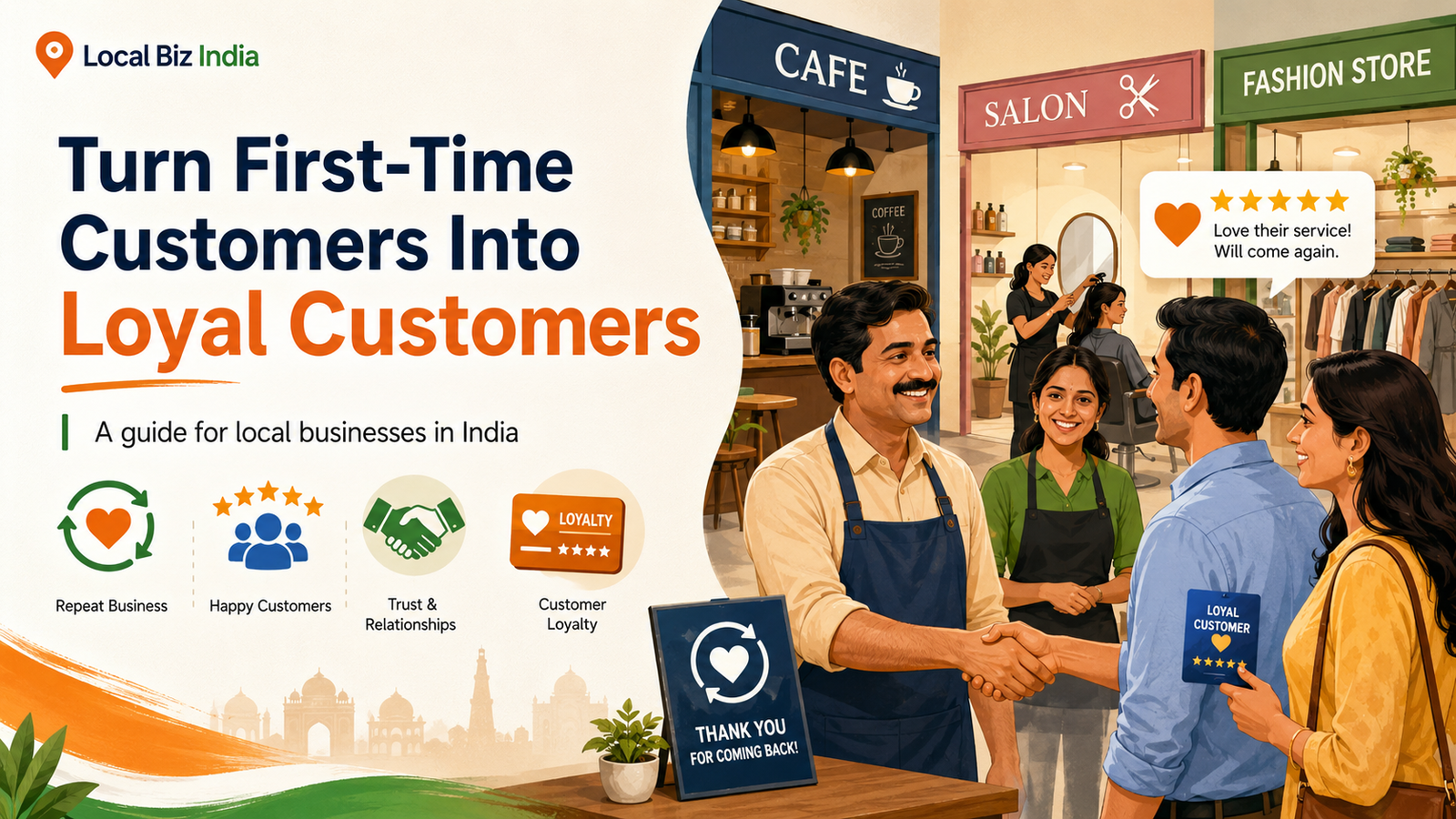
Getting a new customer is exciting for any local business. Whether you run a restaurant, salon, retail shop, repair service, clinic, fitness centre, travel agency, or professional service company, every new customer represents an opportunity.
But attracting someone once is only the beginning.
The real growth starts when that customer chooses your business again.
For local businesses in India, repeat customers can become one of the most valuable sources of long-term growth. They already know your business, understand what you offer, and are more likely to recommend you to friends, relatives, colleagues, and neighbours when they have a positive experience.
That is why local businesses should focus not only on attracting customers but also on giving them reasons to return.
Here are practical ways to turn first-time customers into loyal customers and build stronger relationships with the people you serve.
1. Create a Great First Impression
Customer loyalty often begins during the first interaction.
A customer may discover your business through an online search, a local business directory, social media, a recommendation, or simply by walking past your shop.
Whatever the source, their first experience matters.
Imagine someone visiting a salon for the first time. They are welcomed politely, informed about the expected waiting time, given clear pricing, and treated professionally.
Now compare that experience with a salon where nobody greets them, prices are unclear, and employees seem uninterested.
Which one are they more likely to visit again?
Small details create lasting impressions.
Train your team to greet customers properly, listen carefully to their requirements, answer questions politely, and provide clear information about products, services, prices, and timelines.
Your first goal should be simple: make customers feel comfortable choosing your business.
2. Understand What Your Customers Actually Need
Many businesses focus heavily on selling.
Successful local businesses focus on solving problems.
Before recommending a product or service, understand why the customer has contacted you.
For example, a customer visiting an electronics repair shop may not necessarily want the cheapest repair. They may need their phone repaired urgently because they use it for work.
Similarly, someone visiting a florist may want flowers, but the actual requirement might be finding an impressive anniversary gift that can be delivered that evening.
Understanding the reason behind the purchase allows businesses to provide better recommendations.
Ask useful questions.
What are they looking for?
When do they need it?
What is their approximate budget?
Are there any special requirements?
Listening carefully helps you recommend the right solution instead of simply trying to sell the most expensive option.
Customers remember businesses that understand them.
3. Provide Clear and Honest Pricing
Unexpected charges are one of the fastest ways to lose customer trust.
Customers should understand what they are paying for before the service begins whenever possible.
This is particularly important for repair services, beauty treatments, professional services, home maintenance, healthcare, event services, and other businesses where prices may vary depending on the requirement.
If additional charges might apply, explain them clearly.
For example:
“The basic service costs ₹1,200. If replacement parts are required, we will inform you of the price before replacing anything.”
That simple explanation gives customers confidence.
Transparent businesses are easier to trust, and trusted businesses are easier to return to.
Avoid creating a situation where customers feel the final bill is very different from what they expected.
4. Make Communication Easy
Customers today expect businesses to be easy to contact.
A phone number is useful, but many customers also prefer messaging businesses through WhatsApp or social media.
Make your contact details easy to find.
Your business profile should clearly display important information such as your phone number, address, working hours, website, services, and other relevant details.
When customers contact you, try to respond professionally and within a reasonable time.
You do not need to reply within seconds.
What matters is that customers know their enquiry has been received and that someone will assist them.
Even a simple message such as:
“Thank you for contacting us. Please share your requirement and our team will assist you shortly.”
creates a more professional experience than leaving the customer without any response.
5. Deliver What You Promise
Reliability creates loyalty.
If you promise delivery by 6 PM, make every reasonable effort to deliver by 6 PM.
If a repair will require three days, avoid promising that it will be completed tomorrow simply to secure the customer.
If a product is unavailable, tell the customer instead of accepting the order and dealing with the problem later.
Customers generally understand that delays and unexpected situations sometimes happen.
What frustrates them is poor communication.
If something changes, inform them.
A business that consistently delivers what it promises gradually develops a reputation for reliability.
And customers often prefer reliable businesses over constantly searching for new alternatives.
6. Remember Your Regular Customers
People appreciate recognition.
You do not need an expensive customer-management system to provide personalised service.
Even small gestures can make a difference.
A restaurant may remember a regular customer's preferred table.
A salon may remember their usual haircut or treatment.
A florist may remember that a customer frequently orders anniversary flowers.
A pet-grooming business may remember the pet's name.
These details make interactions feel more personal.
Of course, businesses should handle customer information responsibly and respect privacy. The objective is not to collect unnecessary personal information.
It is simply to make returning customers feel recognised rather than treating every visit as if it were their first.
7. Offer a Simple Loyalty Benefit
Customers like having a reason to come back.
A loyalty programme does not have to be complicated.
A café might offer a complimentary drink after several purchases.
A salon might provide a small discount on a customer's fifth visit.
A car wash might offer a package for repeat customers.
A restaurant might provide a special offer for regular diners.
The important thing is to keep the system simple.
Customers should understand the benefit immediately without reading complicated terms and conditions.
You can also reward loyalty through early access to new products, priority bookings, complimentary upgrades, occasional discounts, or small surprises.
The reward does not always need to be expensive.
Recognition itself can be valuable.
8. Follow Up After Important Purchases
A follow-up message can show customers that your relationship with them did not end immediately after payment.
This is especially useful for higher-value products and services.
For example, a home-service provider could send:
“Hi, we wanted to check whether everything is working properly after yesterday's service. Please let us know if you need any assistance.”
A furniture company might check whether delivery and installation went smoothly.
A beauty clinic could ask whether the customer is satisfied after a treatment.
Follow-ups can achieve two things.
First, they demonstrate good customer service.
Second, they allow you to identify problems before an unhappy customer simply decides never to return.
Keep follow-up communication helpful rather than constantly promotional.
9. Handle Complaints Professionally
Every business will eventually receive a complaint.
Even excellent businesses make mistakes.
What matters is how those mistakes are handled.
Avoid becoming defensive immediately.
Listen to the customer.
Understand what happened.
Check the facts.
Explain the situation clearly and offer a reasonable solution when appropriate.
If your business made a mistake, acknowledge it and focus on resolving the problem.
Sometimes, a customer who experiences a problem but receives excellent support afterward can become more loyal than a customer who never experienced a problem.
Professional complaint handling can protect both customer relationships and business reputation.
10. Ask Customers for Feedback
Do not wait for customers to complain before learning what can be improved.
Ask for feedback.
Questions can be simple:
“How was your experience?”
“Was everything satisfactory?”
“Is there anything we could improve?”
Customer feedback can reveal problems that business owners do not always notice themselves.
Maybe customers find parking difficult.
Perhaps your booking process is confusing.
Maybe your team is taking too long to answer WhatsApp enquiries.
Perhaps customers love one particular product you have not been promoting enough.
Look for patterns instead of reacting dramatically to every individual comment.
Repeated feedback is often where the most valuable improvements are found.
11. Make It Easy for Customers to Find You Again
A customer may love your service today and completely forget your business name six months later.
That is why maintaining an accurate online presence matters even for repeat business.
Keep your business information consistent and easy to discover.
Customers should be able to find your name, location, phone number, working hours, services, website, social profiles, and other useful information without difficulty.
A complete listing on a platform such as Local Biz India can create another place where customers can discover or rediscover your business.
This becomes particularly useful when customers remember the type of business they visited but cannot remember every detail.
The easier you are to find, the easier you are to choose again.
12. Give Customers a Reason to Recommend You
Word-of-mouth remains extremely valuable for local businesses.
People frequently ask friends and family questions such as:
“Do you know a good dentist nearby?”
“Can you recommend a reliable AC repair company?”
“Which restaurant should we try?”
“Do you know a good photographer?”
“Where did you get your car repaired?”
Every satisfied customer can potentially introduce your business to someone else.
You do not necessarily need to ask customers repeatedly for referrals.
Provide an experience worth talking about.
Good quality, honest pricing, dependable service, friendly employees, helpful communication, and professional problem-solving naturally encourage recommendations.
You can occasionally remind happy customers that referrals are appreciated, but customer satisfaction should always come first.
13. Stay Connected Without Becoming Annoying
Keeping in touch with customers can encourage repeat business, but excessive promotional messages can have the opposite effect.
If customers have agreed to receive updates, communicate when you genuinely have something useful to share.
Examples include new products, seasonal offers, appointment reminders, important business updates, special events, useful tips, or loyalty rewards.
The key is relevance.
A useful monthly message may perform better than promotional messages every day.
Give customers reasons to look forward to your communication instead of muting your business.
14. Train Employees to Value Repeat Customers
Customer loyalty cannot depend only on the owner.
Every person representing your business contributes to the customer experience.
Employees answering calls, responding to messages, handling payments, providing services, delivering products, or meeting customers should understand the importance of professional service.
Create simple standards for your team.
How should customers be greeted?
How quickly should enquiries be answered?
What should happen when a customer complains?
Who can approve a refund or replacement?
How should employees communicate delays?
Clear processes create more consistent experiences.
Consistency is important because customers want to know what to expect whenever they return.
15. Measure Repeat Business
Finally, pay attention to how many customers actually return.
Even a small business can track basic information.
Look at how many customers are new versus returning, which products encourage repeat purchases, how often customers come back, what complaints appear repeatedly, and which marketing channels generate the most loyal customers.
You do not need complicated reports to begin.
The objective is to understand whether your business is building relationships or constantly replacing customers who never return.
If you attract many first-time customers but almost nobody comes back, investigate why.
The answer might reveal one of the most important opportunities for improving your business.
Why Loyal Customers Matter for Local Businesses
Local businesses often operate in competitive markets.
Customers may have dozens of restaurants, salons, shops, clinics, service providers, and professionals to choose from in the same city.
Competing only on price can become difficult.
Customer experience provides another advantage.
A customer who trusts your business does not need to compare ten alternatives every time they need the same service.
They already know where to go.
That relationship can create repeat purchases, recommendations, better reviews, and stronger local recognition over time.
Final Thoughts
Business growth is not only about finding more customers.
It is also about taking better care of the customers you already have.
Create a strong first impression. Listen carefully. Be transparent about pricing. Communicate clearly. Keep your promises. Handle complaints professionally. Ask for feedback. Recognise regular customers and give them reasons to return.
None of these strategies require a massive advertising budget.
They require consistency.
For local businesses across India, customer loyalty can become one of the strongest foundations for long-term growth.
And while delivering an excellent customer experience should happen offline as well as online, customers must still be able to find your business when they need you again.
Keeping accurate business details and maintaining a complete presence on platforms such as Local Biz India can make it easier for both new and returning customers to discover your services, understand what you offer, and contact your business.
A first-time customer is valuable.
A customer who keeps coming back—and recommends you to others—can be even more valuable.
Frequently Asked Questions
1. How can local businesses turn first-time customers into loyal customers?
Local businesses can build customer loyalty by providing excellent service, transparent pricing, clear communication, consistent quality, personalized experiences, loyalty rewards, and professional after-sales support.
2. Why is customer retention important for local businesses in India?
Customer retention helps local businesses generate repeat sales, reduce dependency on constantly finding new customers, increase referrals, and build a stronger reputation within their local community.
3. What is the best way to encourage customers to return?
The best approach is to provide a consistently positive experience. Businesses can also offer loyalty rewards, follow-up messages, personalized recommendations, special offers, and reliable customer support.
4. Do loyalty programs help small businesses?
Yes. Simple loyalty programs can encourage customers to make repeat purchases. Discounts, reward points, complimentary services, or special benefits for regular customers can increase customer engagement and retention.
5. How can WhatsApp help local businesses retain customers?
WhatsApp can be used for appointment reminders, order updates, customer support, follow-ups, new product announcements, and special offers. Businesses should avoid excessive promotional messaging and only contact customers who have agreed to receive updates.
6. How should a local business handle customer complaints?
Businesses should listen carefully, understand the issue, remain professional, explain the situation clearly, and offer a reasonable solution whenever appropriate. Handling complaints effectively can help restore customer trust.
7. How can customer reviews help a local business grow?
Positive customer reviews can improve trust and help potential customers understand the quality of a business. Reviews also provide useful feedback that businesses can use to improve their products, services, and customer experience.
8. How can local businesses improve customer experience?
Businesses can improve customer experience by training staff, reducing waiting times, providing accurate information, responding quickly to enquiries, maintaining transparent pricing, and making the buying process simple and convenient.
9. How can Local Biz India help local businesses?
Local Biz India helps businesses improve their online presence by providing a platform where customers can discover businesses by location and category, view important business information, and contact suitable service providers.